
Why Most Portable Solar Panel Fails to Charge in High Heat?
The Frustrating Reality of Off-Grid Power Capacity
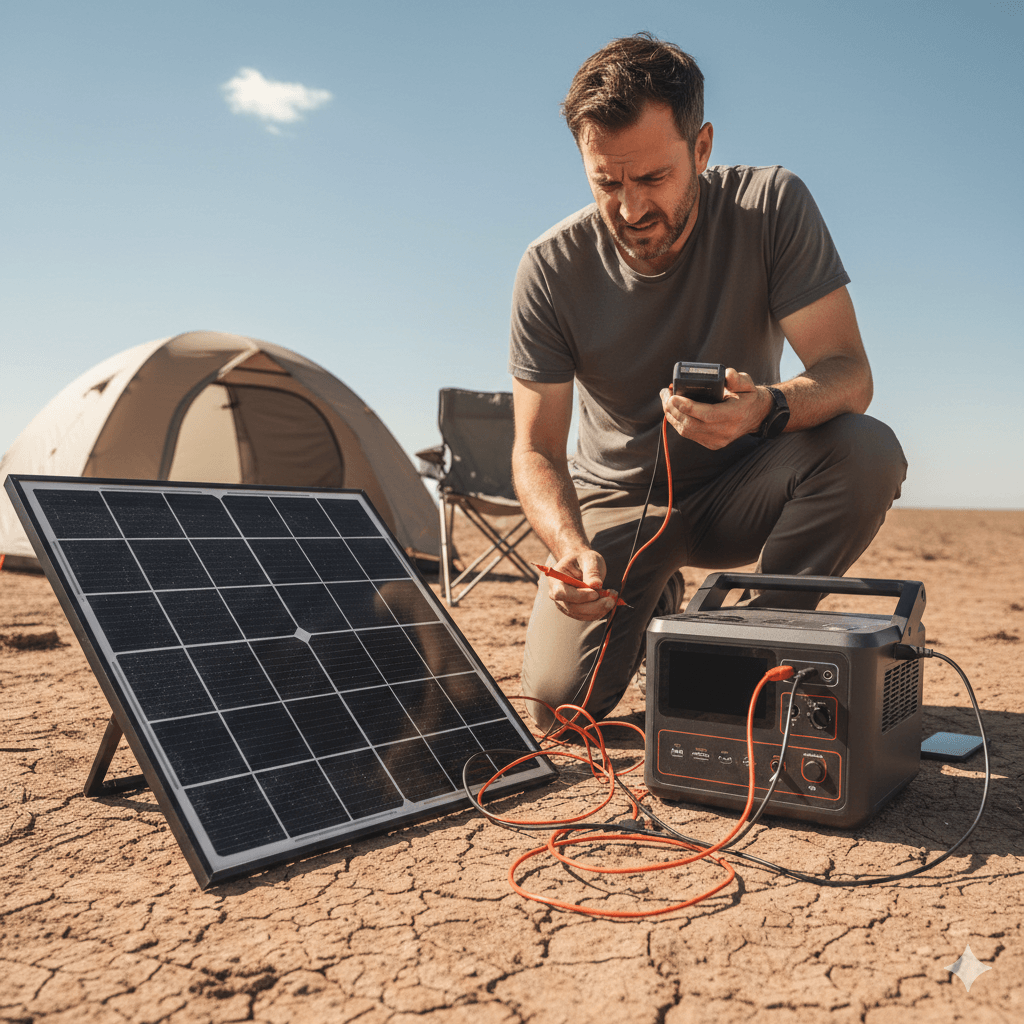
If your portable solar panel fails to charge during an off-grid trip, it can turn a great adventure into a nightmare.You’ve invested in premium portable power gear—a high-efficiency solar panel and a state-of-the-art solar generator like a Jackery Explorer or Bluetti EB3A. You’re miles away from the nearest outlet, expecting a full battery capacity, but you’re met with a dead display. No spark, no charging, no power. It’s a common nightmare, but it’s rarely a hardware failure. Instead, it’s often a technical compatibility gap between traditional solar output and modern LiFePO4 battery requirements.
1. The Voltage Trap: Why Output Matters More Than Watts
The biggest mistake beginners make is focusing solely on “Watts.” While a 100W portable solar panel sounds powerful, solar charging is entirely dependent on Voltage (V).
- The Problem: Most portable panels output between 17V and 20V. However, larger solar stations (like the Bluetti AC200L) often require a minimum input capacity of 24V. If your voltage is too low, your expensive solar generator won’t even trigger the charging circuit.
- The Professional Fix: Ensure your panel’s Voc (Open Circuit Voltage) aligns with your power station’s input range. If it’s too low, connecting two solar panels in Series will double the output and fix the compatibility issue.
2. The LiFePO4 Mystery: MPPT Efficiency and Battery Life
Modern portable power stations utilize LiFePO4 (Lithium Iron Phosphate) chemistry because it offers better battery life and safety. But these batteries are “picky” about their charging source.
- MPPT vs. PWM: If you are using an older solar charger, you are wasting 30% of your energy conversion. LiFePO4 batteries require an MPPT (Maximum Power Point Tracking) controller to bridge the gap between variable sun intensity and the battery’s sensitive charging profile.
- Connectors & Cables: High-quality connectors (like XT60 or MC4) are vital. LiFePO4 systems are sensitive to voltage drops caused by thin extension cables, which can lead to a complete power loss.
3. The Efficiency Killers: Heat and Waterproof Coatings
A solar panel labeled with a 23% Conversion Rate is tested in a lab. In the real world, two “invisible” thieves steal your power capacity:
- Thermal Throttling: Ironically, solar panels hate extreme heat. As temperatures rise above 25°C, the output efficiency drops. On a 40°C day, your portable solar setup produces significantly less charging current.
- The Waterproof Barrier: The ETFE waterproof coating that protects your solar cells also reflects a fraction of sunlight. This “Durability Tax” can reduce your actual output by 5-10%.
4. Your 4-Step Technical Checklist to Restore Power
Follow this professional diagnostic to ensure your solar generator stays charged:
- Validate Output: Use a multimeter to check the Voc. If the panel shows 0V in direct sun, you have a broken cell.
- Inspect Connectors: Ensure your DC7909, XT60, or Anderson connectors are clean. A loose fit creates resistance and kills charging efficiency.
- Optimize Sun Angle: A 10-degree tilt away from the sun can result in a 20% loss in portable power production.
- Update Station Firmware: Modern units from EcoFlow or Bluetti require firmware updates to handle the solar input algorithm correctly.
5. Competitor Comparison: Solar Panel Compatibility
| Brand | Standard Input | Best Feature | Compatibility Note |
| Jackery SolarSaga | 8mm DC | Portable Design | Best for Jackery Explorer |
| Bluetti PV Series | MC4 / XT60 | High Voltage | Ideal for LiFePO4 Systems |
| Goal Zero Nomad | 8mm / APP | Waterproof Build | Rugged Off-Grid Use |
6. Frequently Asked Questions (AEO Section)
Q: Can I use a Jackery solar panel with a Bluetti power station?
A: Yes, provided the connectors are compatible and the solar output voltage falls within the Bluetti station’s input range.
Q: Why is my 100W panel only producing 60W of charging?
A: This is due to real-world conversion losses, including solar angle, heat, and atmospheric haze affecting the panel’s efficiency.
Conclusion: Mastering Your Off-Grid Power
Understanding the exact reasons why a portable solar panel fails to charge is the first step toward becoming a self-reliant off-grid enthusiast. Most issues aren’t caused by broken hardware but by a simple lack of technical alignment between your solar output and your LiFePO4 battery needs. By matching your voltage, using high-quality MPPT controllers, and maintaining the right sun angle, you can effectively fix any situation where your portable solar panel fails to charge.
Don’t let a technical oversight ruin your next adventure. Double-check your connectors, monitor your battery capacity, and keep your gear optimized. Remember, if your portable solar panel fails to charge even in direct sun, the problem is likely in the voltage mismatch we discussed above.
For more optimization tips, visit GrowLogicHub Home.