
Can You
Charge
LiFePO4
Direct?
The voltage gap nobody talks about — and why skipping one $50 component can destroy a $1,000 battery in a single afternoon of sunshine.
last resort,
not a regulator.”
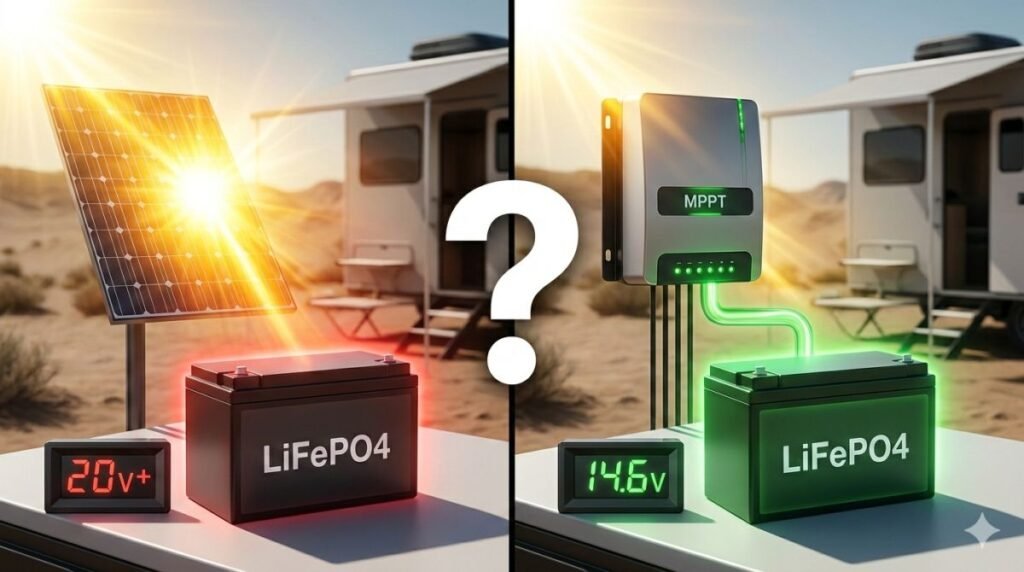
No. Charging a LiFePO4 battery directly from a solar panel is unsafe. The panel’s Open Circuit Voltage (20V+) exceeds the battery’s 14.6V ceiling. Without a charge controller, you risk cell damage, BMS failure, and permanent capacity loss.
Last summer, a man drove three hours to my workshop with a smoking battery enclosure in the back of his truck. His brand-new, $900 LiFePO4 pack was dead — permanently — six weeks after installation. His mistake? He skipped the charge controller because a YouTube video told him it was “probably fine for a 20W panel.”
It wasn’t fine. I’ve seen batteries fry because of this exact shortcut more times than I care to count. In my 10 years of off-grid electrical work and desert camping, nothing destroys a solar setup faster than this single error. So let’s kill this myth — with math, not marketing.
// 01 The Voltage Gap That Kills Batteries
Here’s the core problem. Your “12V” solar panel is not actually 12 volts. Not even close. This is the single most misunderstood fact in consumer solar, and manufacturers bury it deep in the datasheet fine print.
+
Peak open-circuit: 20–22V
What actually hits your battery unregulated
Float: 13.6V
The hard ceiling — no exceptions, ever
That 5–7 volt gap is not a rounding error. It’s the difference between a healthy battery and a $900 paperweight. The moment you bypass a controller, you push 20+ raw volts into a system designed for 14.6V. The cells don’t care about your budget — they absorb the abuse silently, right up until they can’t anymore.
Voltage spikes from direct solar connection can trigger a single catastrophic overcharge event that permanently destroys battery capacity in minutes. Panel wattage is irrelevant — even a 10W panel produces the same Voc danger. Size does not reduce voltage risk.
// 02 Why Your BMS Is Not a Charge Controller
Real-World Logic
Here is the logic you will not find in any product manual: some LiFePO4 batteries technically survive brief direct solar contact — because the BMS cuts power before total destruction. But “survived because the safety net caught it” is not the same as “safe.”
Your Battery Management System is a last-resort guardian, not a primary regulator. Every BMS trip to block overvoltage from an unregulated panel causes cumulative stress damage to its internal MOSFETs. Run it as your default charge controller and it will fail within a season — often silently, leaving your cells completely exposed to the next spike.
Using your BMS as a charge regulator is like relying on airbags as your primary crash-avoidance system. It might save you once. It won’t save you twice.
— Marcus Reid · 10 Years Off-Grid Engineering// 03 The Fix: MPPT vs. PWM Controllers
A charge controller costs less than one dinner. It sits between panel and battery, takes the raw solar output, and delivers exactly what your LiFePO4 needs — nothing more, nothing less. Two types exist:
- PWMBudget · EntryClips excess voltage by rapidly pulsing power on and off. Effective for small systems under 200W where panel and battery voltages are close. Simple, reliable — but wastes 20–30% of available solar energy by not tracking peak output.$15–$45 · ~70% efficiency · Good under 200W
- MPPTPremium · RecommendedActively tracks the panel’s optimal power output point and converts excess voltage into usable current. Delivers 20–30% more energy from the same panel — pays for itself fast. Essential for systems over 200W or any high-Voc panel configuration.$40–$150 · 93–98% efficiency · Best for LiFePO4
| Approach | Cost | Efficiency | LiFePO4 Safe? | Verdict |
|---|---|---|---|---|
| Direct Solar (No Controller) | $0 | Unregulated | Dangerous | Never |
| PWM Controller | $15 – $45 | ~70% | With LiFePO4 Profile | Small Setups Only |
| MPPT Controller | $40 – $150 | 93–98% | Fully Safe | Best Choice |
Portable solar generators are dominating 2026 camping setups — but most budget units ship with lead-acid charge profiles. Before buying, verify your controller has a dedicated LiFePO4 profile (Bulk 14.2V · Absorption 14.6V · Float 13.6V). Victron SmartSolar and Renogy Rover allow full manual configuration. If you see only “Sealed / Gel / Flooded” options — walk away immediately.
The Controller. Ever.
After a decade of solar builds across desert camps, mountain cabins, and full-time van conversions, my answer is absolute: never connect a solar panel directly to a LiFePO4 battery.
The “it worked for me” stories online come from people who haven’t opened their battery yet. Damage accumulates invisibly inside the cells — right up until the day the battery simply won’t charge anymore.
A quality MPPT controller costs $50–$150. A replacement LiFePO4 costs $400–$1,200. The math writes itself. Buy the controller. Set the right profile. Do it once, do it right — and your battery will reward you with 3,000+ cycles of clean power.
The Final Verdict: Efficiency Over Shortcuts
In 2026, off-grid power is no longer a guessing game—it is a science. While the temptation to save $50 by skipping a charge controller might seem logical for a small portable setup, the mathematical risk to your LiFePO4 cells is absolute. A Battery Management System (BMS) is a safety net, not a voltage regulator. To ensure your investment lasts for its promised 3,000+ cycles, always bridge the gap between your solar panels and battery with a dedicated MPPT or PWM controller.
The Golden Rule for 2026: If your panel’s Open Circuit Voltage (Voc) is higher than your battery’s maximum charge voltage (14.6V), a controller is non-negotiable.
For those looking to dive deeper into the official safety standards and chemical stability of Lithium Iron Phosphate cells, you can explore the comprehensive technical documentation on Battery University—the industry’s leading resource for battery engineering.