
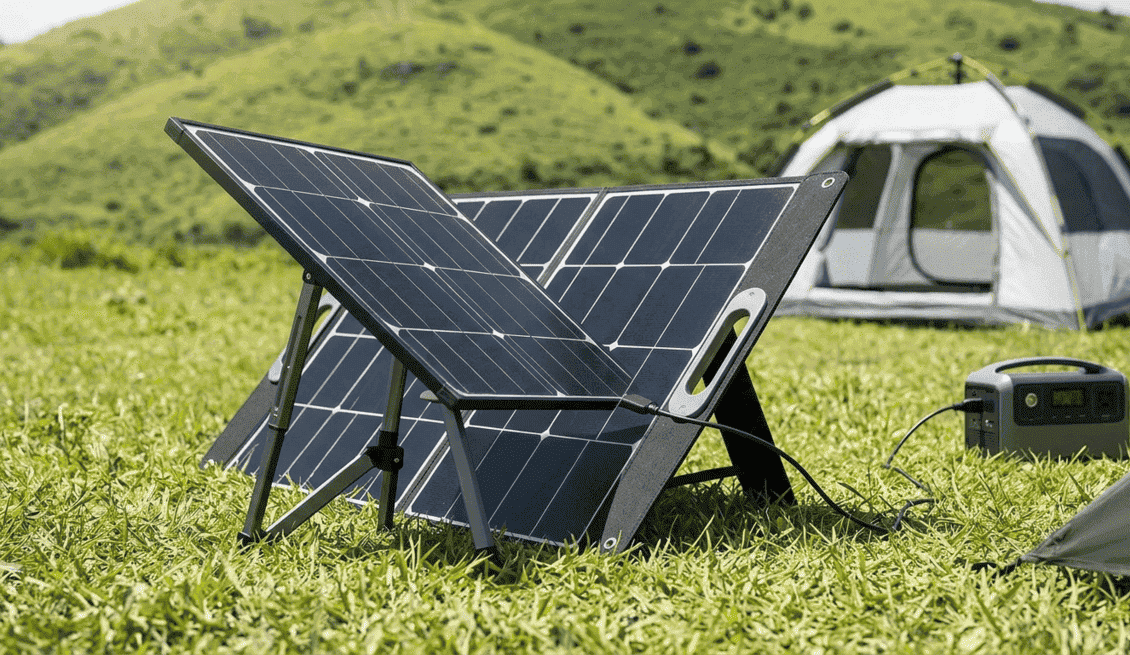
What size solar panel do I need for camping?
If you are in a hurry, use this quick breakdown to choose the right solar panel size for your camping setup:
The honest answer: it depends on your devices, your sun hours, and a
real efficiency buffer — not Amazon’s bestseller badge.
Solo campers need 60–100W, couples need 100–160W, and
families need 200W+. Use the free calculator below to get
your exact number in 10 seconds.
How Many Watts Solar Panel Do I Need for Camping?
🌟 Pro Tip for 2026
If you want to save your main battery power, use a self-powered lighting system. I highly recommend the OGERY Solar String Lights. It has a built-in 5400mAh battery that charges via solar, so it won’t pull a single watt from your main camping solar setup. Plus, it can charge your phone in emergencies!
Check Price & Get 20% Discount Deal on AmazonHow many watts solar panel do I need for camping? The short answer: solo campers need 60–100W, couples need 100–160W, and families need 200W+. But knowing precisely how many watts solar panel you need for camping depends on three variables — your daily energy consumption, your available peak sun hours, and a real-world efficiency buffer.
Most campers get this wrong. They pick a panel based on Amazon’s bestseller badge and end up either underpowered in the field or overpaying for watts they never use.
Understanding how many watts of solar power you need for camping comes down to real math — not guesswork. Use the free calculator below: enter your daily Wh and your location’s peak sun hours, and get your exact minimum panel size in under 10 seconds.
For your exact location’s peak sun hours, use the free Global Solar Atlas (World Bank tool — enter any coordinates).How Many Watts Solar Panel Do I Need for Camping? (Free Calculator)
⚡ Portable Solar Calculator
Find exactly how many Watts you need for camping.
* Includes 25% efficiency buffer for real-world camping conditions.
How to use this calculator:
Step 1 — Add up your daily Wh (Watt-hours):
| Device / Gear | Avg. Daily Use |
|---|---|
| 📱 Smartphone (Full Charge) | 15 – 20 Wh |
| 🔋 Portable Power Bank (20k mAh) | 70 – 80 Wh |
| 💡 Camp Lantern / LED Lights | 15 – 30 Wh |
| 💻 Laptop (1 Full Charge) | 45 – 65 Wh |
| 🏥 CPAP Machine (Per Night) | 30 – 60 Wh |
| ❄️ Mini Camping Fridge (12V) | 300 – 500 Wh |
| 📷 GoPro / Camera Battery | 10 – 15 Wh |
Add up whichever devices apply to your trip and enter that total as your Daily Energy Need.
What Size Solar Panel Do I Need for Camping?
“Size” and “watts” mean the same thing when you’re shopping for a camping solar panel — but the answer depends on your setup, not the panel’s physical dimensions. A 100W monocrystalline panel is the most common “size” for solo and couple campers, measuring roughly 21″ × 47″ folded. A 200W setup (either one large panel or two 100W panels) is the right size for family or overlander use. Use the calculator above to get your exact watt requirement — then match it to the closest standard panel size: 20W, 40W, 60W, 100W, 160W, or 200W+
Step 2 — Enter your Peak Sun Hours:
- Desert / Southwest US: 6–7 hours
- Most of continental US / Europe: 4–5 hours
- Pacific Northwest / UK / overcast: 2.5–3.5 hours
- Pakistan (summer): 5.5–6.5 hours
The calculator adds a built-in 25% efficiency buffer — this covers real-world losses from heat, partial shade, cable resistance, and inverter conversion.
The charge controller type also affects real output — see our comparison of MPPT vs PWM charge controllers to understand which one to pair with your panel.
Why Most Campers Buy the Wrong Size Panel
The most common mistake: buying a panel based on Amazon’s “bestseller” badge instead of actual watt requirements.
A 100W panel sounds powerful. But if you’re camping in a forested area with only 3 peak sun hours, that same 100W panel only reliably produces 225 Wh per day after losses — barely enough for a laptop charge and a phone.
Run the numbers first. The calculator above does this in under 10 seconds.
How Many Watts Solar Panel for Common Camping Setups
Solo Backpacker — Phone + GPS + Headlamp
Daily need: ~40–60 Wh Recommended: 20–40W panel Top pick: Renogy E.FLEX 21W or BigBlue 3 28W
A lightweight foldable panel under 1.5 lbs handles everything. No power station needed — charge via USB directly.
Weekend Camper — Phone, Lights, Camera, Power Bank
Daily need: 100–150 Wh Recommended: 60–80W panel Top pick: Jackery SolarSaga 60W or Anker 625 60W
This is the sweet spot for most casual campers. A 60–80W panel paired with a 240–300 Wh power station gives you reliable power without heavy gear.
Couple Car Camping — Two Phones, Laptop, Lights, Fridge
Daily need: 400–600 Wh Recommended: 100–160W panel Top pick: Jackery SolarSaga 100W or EcoFlow 160W
Two people with multiple devices need more buffer. A 100W panel in 5 sun hours delivers roughly 375 Wh after losses — enough for most couples if the fridge draws are moderate.
Family / Overlander — Full Setup + Fridge + CPAP
Daily need: 700–1,200 Wh Recommended: 200W+ (dual 100W panels) Top pick: Two × Jackery SolarSaga 100W in parallel, or Rocksolar 200W
For serious setups, a single panel is rarely enough. Two 100W panels in parallel double your harvest without doubling complexity — most quality power stations support dual-panel input.
The Formula Behind the Calculator
If you want to calculate solar panel size for camping manually:
Required Watts = (Daily Wh ÷ Peak Sun Hours) × 1.25
Example:
- Daily need: 300 Wh
- Peak sun hours: 5
- Raw result: 300 ÷ 5 = 60W
- With 25% buffer: 60 × 1.25 = 75W minimum
So you’d want at minimum a 100W panel (the next standard size up from 75W).
Always round up to the next available panel size — panels rarely hit 100% rated output in real conditions.
NREL Solar Research
confirms real-world panel output averages 70–80% of rated wattage
under field conditions.
Does Panel Wattage = Guaranteed Output?
No — and this surprises most first-time buyers.
A 100W panel produces 100W only under lab-standard conditions (STC: 25°C, 1000 W/m², zero humidity). Real camping conditions are different:
- Heat: Panel efficiency drops ~0.4% per °C above 25°C. A panel at 45°C loses ~8% output.
- Angle: A panel lying flat instead of angled toward the sun can lose 20–30% output.
- Partial shade: Even a small shadow on one cell can cut output by 50%+ on panels without bypass diodes.
- Cable loss: Long DC cables lose 2–5% in resistance.
This is exactly why the calculator includes the 25% buffer — it’s not padding, it’s physics.
According to U.S. Department of Energy,
STC ratings rarely reflect actual field performance.
Camping solar guide
Monocrystalline vs Polycrystalline Solar Panels
For camping, monocrystalline wins every time. The weight and size savings justify the higher price — especially on multi-day trips where every gram matters.
🌟 Pro Tip for 2026
If you want to save your main battery power, use a self-powered lighting system. I highly recommend the OGERY Solar String Lights. It has a built-in 5400mAh battery that charges via solar, so it won’t pull a single watt from your main camping solar setup. Plus, it can charge your phone in emergencies!
Check Price & Get 20% Discount Deal on AmazonMonocrystalline panels achieve 20–24% efficiency under standard conditions (learn more: Solar panel — Wikipedia).Camping World’s solar guide also recommends monocrystalline for portable setups.
How to Get More Power from the Panel You Already Have
Already own a panel and want to maximize output? These four steps are free:
1. Angle toward the sun. Adjust panel angle every 2–3 hours if stationary. A kickstand panel angled at the sun beats a flat panel by 20–30%.
2. Keep it cool. Don’t lay the panel on hot sand or a black vehicle roof. Elevate it slightly — airflow under the panel keeps cell temperature down and efficiency up.
3. Clean the surface. Dust, bird droppings, and pollen cut output. A damp cloth wipe before your morning session recovers 5–15% on dirty panels.
4. Minimize cable length. Use the shortest DC cable that reaches your battery. Every extra meter costs wattage.
Frequently Asked Questions
How many watts solar panel do I need to charge a power station at camp? Match panel wattage to your power station’s solar input rating. Most 300–500 Wh stations accept 100–200W input. A 100W panel gives a full charge in 3–5 hours of good sun. Use the calculator above to see if that matches your daily drain.
Can I use two solar panels together while camping? Yes — most portable power stations support dual-panel input via a parallel Y-connector. Two 100W panels act as a single 200W source. Check your power station’s max solar input before connecting — exceeding it can damage the charge controller.
What if I camp in a cloudy area? Use a lower peak sun hours value in the calculator (2.5–3 hours). The result will push you toward a larger panel, which is the correct response to low-sun environments. Alternatively, carry a larger battery capacity and charge less frequently.
Is 100W enough for camping with a fridge? Probably not on its own. A 12V camping fridge draws 300–500 Wh daily depending on ambient temperature. A 100W panel in 5 sun hours produces ~375 Wh after losses — right at the edge. For fridge camping, 160–200W is the safer recommendation.
Do solar panels work through a tent or tarp? No. Most tent fabrics block UV and visible light enough to cut output by 80–95%. Panels need direct unobstructed sky exposure to work.
What size solar panel do I need for camping as a beginner?
Start with a 100W panel — it covers the most common beginner
setup (phone, lights, laptop) and works with most portable
power stations under 500Wh.
Still asking what size solar panel do I need for camping?
The table below gives instant answers by trip type.
Quick Reference — Watts by Camping Type
| Camping Style | Daily Wh Need | Panel Size |
|---|---|---|
| Solo backpacker | 40–80 Wh | 20–40W |
| Weekend solo camper | 80–150 Wh | 40–60W |
| Couple, car camping | 200–400 Wh | 100W |
| Family, full setup | 500–800 Wh | 160–200W |
| Overlander + fridge | 800–1,200 Wh | 200W+ |
Use the calculator at the top for a number specific to your devices — these ranges are starting points, not substitutes for your actual numbers.
Bottom Line
The question “how many watts solar panel do I need for camping?” has one honest answer: it depends on your devices, your sun hours, and your efficiency losses. The calculator on this page handles all three variables in one step.
Run your numbers → round up to the next panel size → check compatibility with your battery system. That’s the entire decision.
Looking for specific panel recommendations matched to your watt result? See our guide to the best portable solar panels for camping for picks across every wattage range.
Still unsure how many watts solar panel you need for camping? Run the calculator one more time with conservative sun hours (3–4) rather than ideal ones. Sizing up slightly — the next standard wattage above your result — is always the smarter call for real camping conditions.Once you know your required watts, see our tested picks for the best portable solar panels for camping in 2026 matched to every wattage range
Questions about your specific setup? Drop them in the comments — happy to help you size it correctly.