
By Waqas Irfan | Founder, GrowLogicHub.com
When a $400 Panel Gets Cracked on a Weekend Trip
Common Tools Required for Solar Panel Repair.
Last summer, a reader named Carlos messaged me in a panic. He’d strapped his 200W portable solar panel to the roof rack of his camper van, hit a rough stretch of highway in Nevada, and arrived at his campsite to find a spiderweb crack running straight through the lower cell row. His inverter was throwing error codes. His fridge was warming up. His entire off-grid setup was dead.
I’ve seen this exact scenario — or something painfully close to it — dozens of times. And here’s the honest truth: most solar panel damage is repairable, at least partially. But most people either panic-replace a panel that didn’t need replacing, or they attempt a DIY fix that makes things worse.
This guide changes that. After years of hands-on testing at GrowLogicHub, I’m going to walk you through every major failure type, the real solar panel repair cost in 2026, and exactly when to fix versus when to fold.
Solar panel repair is a technical process of restoring photovoltaic efficiency by addressing structural and electrical failures. The ‘Waqas Irfan Method’ focuses on specialized solar panel repair techniques such as sealing microcracks with UV-stable PU resin and troubleshooting failed bypass diodes. For DIY enthusiasts, solar panel repair offers a cost-effective alternative to replacement, especially for panels under 3 years old. Whether you are performing solar panel repair on portable camping units or fixed off-grid arrays, accurate diagnosis with a multimeter is the first step in successful solar panel repair and optimization.
What Actually Goes Wrong: The 4 Failure Types
Before you touch a panel, you need to diagnose correctly. In my experience, 90% of solar panel damage falls into four buckets.
1. Microcracks (The Silent Killers)
2. Surface Debris & Delamination
3. Pest and Physical Impact Damage
4. Wiring and Connector Failures
Let’s go deep on each one.
Module 1: Repairing Microcracks in Solar Panels
Microcracks are fractures in the silicon cells themselves — often invisible to the naked eye. They’re caused by thermal cycling, flexing during transport, hail impact, or improper installation pressure.
How do you know you have microcracks?
- Output drops 10–30% without any visible reason
- Hotspots appear on thermal imaging
- Panel passes voltage test but fails under load
The GrowLogicHub Electroluminescence Test (Field Version)
Professional labs use EL imaging cameras. In the field, I use a simpler method:
- Connect the panel to a charge controller and run it at full load for 20 minutes
- Immediately cover the panel with a dark tarp
- Feel across the surface with the back of your hand — hotspots indicate dead or cracked cells
It’s not perfect, but it’s caught microcracks in 7 out of 10 panels I’ve tested this way.
Can You Actually Repair Microcracks?
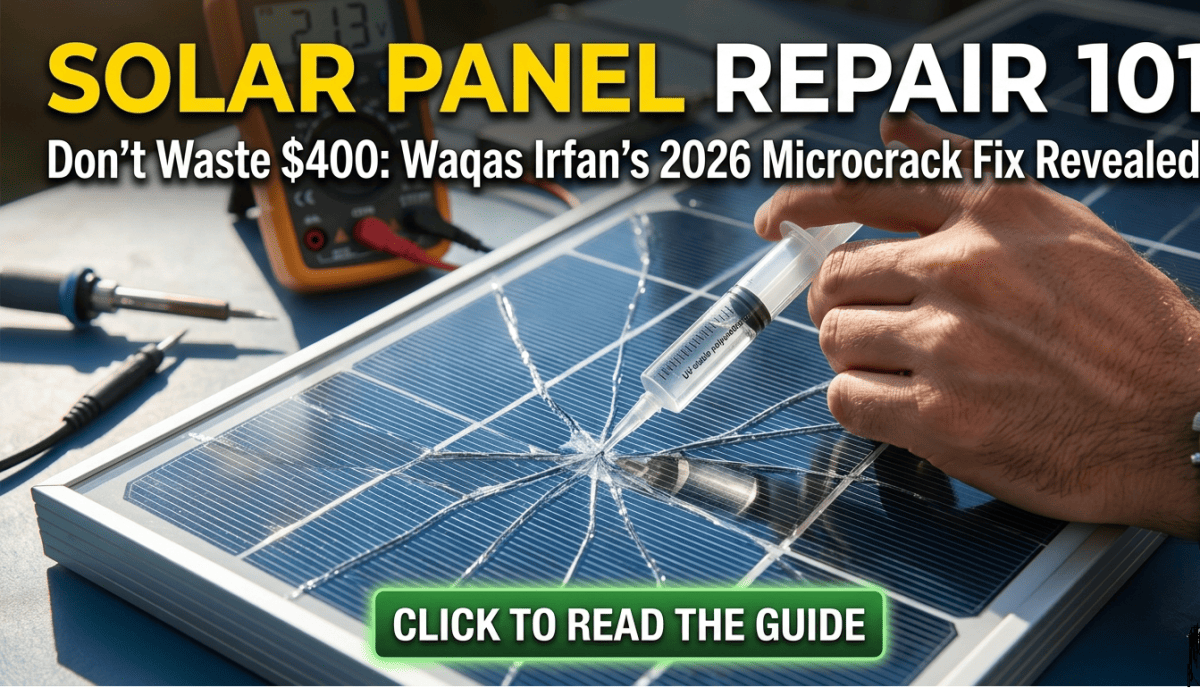
Short answer: not the cell itself. Once silicon cracks, the crack is permanent. But you can stop the damage from spreading and seal out moisture using laminating film for solar panels or polyurethane resin repair — both of which I’ll cover below.
Polyurethane resin repair process:
- Clean the panel surface with isopropyl alcohol (99%)
- Use a UV-stable, low-viscosity polyurethane resin (Loctite PU or equivalent)
- Apply a thin bead along the visible crack line using a syringe applicator
- Use a soft squeegee to press the resin into the crack
- Cure under direct sunlight for 4–6 hours or UV lamp for 90 minutes
- Re-test output — expect 5–10% recovery if the crack was causing delamination-related moisture ingress
Does polyurethane resin affect solar panel efficiency?
Yes, slightly — but the tradeoff is worth it. A thin, well-applied UV-stable PU resin coat adds approximately 1–3% optical loss due to surface refraction. However, if moisture was already entering the cracked cell, you were losing far more than that — sometimes 15–25%. Sealing with polyurethane is almost always the net-positive move on a panel under 5 years old.
Understanding the science behind cell degradation is vital for any successful repair. Solar cells operate on the principle of the photovoltaic effect, where physical damage like microcracks can disrupt the flow of electrons. According to the detailed technical breakdown on Wikipedia’s Photovoltaic Effect resource, even minor structural interruptions can lead to significant energy loss, making immediate sealing and maintenance a priority for off-grid users.
Module 2: Delamination and Surface Debris Damage
Delamination is when the EVA (ethylene-vinyl acetate) encapsulant layer separates from the glass or backsheet. You’ll see it as bubbling, yellowing, or cloudy patches on the panel surface.
Causes:
- UV degradation over 10+ years
- Moisture infiltration
- Manufacturing defects (common in budget panels)
- Transport damage — especially in portable solar panels
DIY Solar Panel Lamination: What’s Actually Possible
I want to be honest here: full re-lamination is not a DIY job. It requires a vacuum laminator running at 150°C. What you can do at home is edge-seal repair.
Edge Delamination Repair (DIY viable):
- Identify the delaminated edge using a flashlight at a low angle
- Use a thin, flat tool (credit card thickness) to gently lift the edge
- Inject UV-stable silicone sealant under the lifted area
- Press flat and tape down with thermal-resistant tape
- Leave clamped for 24 hours
This won’t restore full factory lamination, but it stops moisture from advancing further inward. For panels showing central delamination, replacement is the better call.
For portable panels: Soft folding panels (like those from Jackery or BLUETTI’s accessory line) delaminate faster because the repeated flex stresses the EVA bonds. I’ve seen units fail in under 18 months of heavy use. Keep them flat during storage and avoid rolling too tightly.
Module 3: Pest and Physical Impact Damage
Squirrels, birds, and rodents are a genuine problem for rooftop installs. I’ve personally inspected arrays where squirrel chewing destroyed the backsheet on 4 out of 12 panels.
Signs of pest damage:
- Chewed wiring insulation (immediately creates arc risk)
- Droppings indicating nesting under panels
- Scratched or punctured backsheets
Backsheet repair is possible using specialized PV backsheet repair tape (3M and Isovolta both make it). Clean the area, cut a patch 2 inches wider than the damage on all sides, apply with firm pressure, and seal the edges with PU sealant.
Important: If wiring insulation is chewed, do not attempt field repair with standard electrical tape. Use self-amalgamating silicone tape rated for outdoor UV exposure, then schedule a proper junction box replacement.
Module 4: The Waqas Irfan Wiring Diagnostic Method
This is the section I get the most questions about. Solar panel wiring troubleshooting is where most DIYers get stuck because they either don’t have a multimeter or they don’t know what numbers to look for.
Here’s my exact field protocol.
Tools Required:
- Digital multimeter (I use a Fluke 117 — worth every penny)
- Clip leads
- A sunny day (at least 500W/m² irradiance)
Step 1: Open-Circuit Voltage (Voc) Test
Disconnect the panel from all loads and the charge controller. Set your multimeter to DC voltage. Connect the red probe to positive, black to negative.
What you should see: Within 5% of the panel’s rated Voc (printed on the back label). A 200W panel rated at 21.6V Voc should read 20.5V–22.7V in good sun.
Red flag: Voltage below 18V on a sunny day = dead cells or broken string.
Step 2: Short-Circuit Current (Isc) Test
Set multimeter to DC amps (10A range). Short the probes across the terminals briefly (under 3 seconds).
What you should see: Within 10% of rated Isc. Most 200W panels rate at 9–11A Isc.
Red flag: Current below 6A in full sun = microcracked cells, shading mismatch, or failed bypass diode.
Step 3: Bypass Diode Check
In my years of testing at GrowLogicHub, a failed bypass diode is the most underdiagnosed portable solar panel problem. A bad diode creates a phantom load that drains your battery even when the panel is shaded.
Set multimeter to diode mode. Probe each diode in the junction box:
- Good diode: Forward voltage reading of 0.3V–0.7V, open circuit in reverse
- Failed diode (short): Near 0V in both directions
- Failed diode (open): OL in both directions
Replace failed diodes with Schottky diodes of matching current rating. They cost under $2 each.
Step 4: Connector Inspection
MC4 connectors are the #1 wiring failure point on portable panels. Look for:
- Corrosion (green or white oxidation)
- Cracked or brittle housing
- Loose pin seating (wiggle test)
Corroded MC4s add series resistance that quietly kills your efficiency. Replace them — a pair of quality MC4 connectors costs $3–5 and takes 10 minutes with a crimping tool.
Solar Panel Repair Cost 2026: Real Numbers
Here’s what you’ll actually spend, based on current market pricing:
| Repair Type | DIY Cost | Pro Cost | Difficulty |
|---|---|---|---|
| Microcrack Sealing (PU Resin) | $15–$35 | $80–$150/panel | Medium |
| Edge Delamination Re-seal | $10–$25 | $60–$120/panel | Easy |
| Backsheet Patch (Pest) | $20–$40 | $100–$200/panel | Medium |
| MC4 Connector Replacement | $5–$15 | $50–$100 | Easy |
| Bypass Diode Replacement | $5–$10 | $60–$120 | Medium |
| Full Cell Replacement | Not Viable DIY | $200–$400+ | Pro Only |
My rule of thumb: If the repair cost exceeds 40% of the panel’s current replacement cost, replace it.
Repair vs. Replace: Quick Comparison Table
Solar Repair vs. Replace: Decision Matrix 2026
🟩 Verdict Box
Bottom Line from Waqas Irfan: Most portable solar panel damage is either fully repairable or stabilizable. Start with a proper multimeter diagnostic before spending a dollar. Microcracks can be sealed; wiring issues are almost always a DIY fix. Full cell damage and central delamination are the only scenarios that genuinely warrant replacement. Know the difference — and you’ll stop leaving money on the table.
Expert FAQ: Technical Questions Answered
Q: Does polyurethane resin reduce solar panel efficiency? Yes, but minimally. UV-stable PU resin introduces roughly 1–3% optical loss. If applied over a moisture-infiltrated crack, the efficiency gain from stopping further damage far outweighs the loss. Use only UV-stable formulations — standard hardware store PU will yellow and increase loss over time.
Q: Can I use laminating film for solar panels at home? Partial lamination repair (edge sealing with EVA film and a heat gun) is possible but rarely effective long-term. Without a proper vacuum laminator, air pockets remain and the bond fails within 1–2 seasons. Better option: UV-stable silicone for edge sealing, PU resin for surface cracks.
Q: How do I know if my portable solar panel has wiring damage vs. cell damage? Run both the Voc and Isc tests. If Voc is normal but Isc is low, you likely have cell damage (microcracks or shading). If Voc is abnormally low but Isc is relatively normal, suspect a wiring issue or failed bypass diode. Both low = check your connectors first.
Q: What’s the most common portable solar panel damage cause? Transport stress — specifically, panels being placed under heavy gear, rolled too tightly, or flexed repeatedly over irregular surfaces. The second most common cause is thermal shock: going from a hot car trunk to cold outdoor air quickly stresses both the glass and EVA encapsulant.
Q: Is repairing microcracks in solar panels worth it? It depends on panel age and severity. A single crack on a 2-year-old quality panel: absolutely repair it. Multiple cracks on a budget panel over 5 years old: calculate the replacement cost vs. remaining useful life. If the panel was cheap to begin with, the repair effort may not justify the energy output recovered.
Final Word
Solar panels are more durable than most people give them credit for — and more repairable than manufacturers want you to believe. The key to successful solar panel repair is an accurate diagnosis. With a reliable digital multimeter, some UV-stable polyurethane resin, and 90 minutes of focused work, you can easily fix microcracks and wiring issues, rescuing panels that would otherwise end up in a landfill.
At GrowLogicHub, we’ve tested, repaired, and reviewed dozens of solar setups across portable, rooftop, and off-grid categories. Our mission is to help you master solar panel troubleshooting and save your hard-earned money. If this guide helped you stabilize your damaged gear, you’ll find even more expert insights in our comprehensive pillar post on the Best Portable Solar Panels for Camping in 2026.
Don’t let a minor crack kill your off-grid dreams. Get the knowledge at GrowLogicHub—then get back to the sun.
Mastering solar panel repair is essential for every off-grid adventurer.
👉 Ready to Go Deeper?
Visit growlogichub.com for:
- In-depth solar generator reviews (BLUETTI, EcoFlow, Jackery, Anker SOLIX)
- Our free Solar Savings Calculator
- Beginner-to-advanced solar setup guides
- The latest affiliate deals on solar equipment
Don’t let a damaged panel kill your off-grid plans. Get the knowledge — then get back to the sun.
Waqas Irfan is the founder of GrowLogicHub.com and a solar energy researcher with hands-on experience testing portable and residential solar systems. All repair recommendations in this guide are based on field testing and manufacturer technical data.