
By Waqas Irfan | GrowLogicHub Engineering Insights | Senior Thermal Engineer & Off-Grid Living Expert, 15 Years
In this guide, we break down the essential Off-Grid Thermal Logic 2026 for engineers and off-grid enthusiasts.
Quick Logic Summary
In 2026, off-grid thermal survival requires more than shade and insulation. Portable power stations fail above 45°C due to BMS throttling. Sub-ambient radiative cooling exploits the 8–13 μm atmospheric window to dump heat into deep space. 10AWG copper wire is non-negotiable as heat increases resistance. Phase Change Materials and Earth-Air Heat Exchangers deliver passive thermodynamic control without electricity. Master the physics first — the installation follows logically.
The Core Principles of Off-Grid Thermal Logic 2026
Off-Grid Thermal Logic is the systematic application of thermodynamic physics — heat transfer, radiation physics, and material science — to protect energy systems, human bodies, and structures from extreme temperatures without reliance on grid power. In 2026, with Universal Thermal Climate Index (UTCI) values rising globally by an estimated 5°C above pre-industrial baselines (source: Springer Nature, 2025), traditional passive cooling strategies such as whitewash paint and ventilation gaps are failing at the physics level, not just the comfort level. This guide is your engineering correction. Before diving into thermal management, make sure your solar harvest is already optimized — because a thermally degraded system running on weak solar input is a double failure. Read the full breakdown in Solar Energy Efficiency 2026: What’s Actually Changed.
The 2026 Thermal Reality: Why Old Logic Is Dead
Before we go section by section, understand the baseline problem. The thermal stress humans and electronics face in 2026 is categorically different from the thermal stress of 2010.
UTCI +5°C — What It Actually Means for Off-Grid Systems
The Universal Thermal Climate Index is not merely an air temperature reading. It integrates air temperature, humidity, wind speed, and mean radiant temperature into a single physiological stress value. A UTCI of +46°C — now recorded in parts of South Asia, MENA, and Sub-Saharan Africa — represents extreme heat stress where human thermoregulation begins to fail within 20–30 minutes of outdoor exposure without mechanical cooling.
For off-grid engineers, the critical insight is this: your equipment is experiencing the same physiological crisis your body is. Lithium cells, copper wiring, and foam insulation are all subject to the same thermodynamic laws you are. The difference is that your equipment doesn’t sweat.
Pakistan’s National Disaster Management Authority (NDMA) reported 44°C+ sustained temperatures across Punjab and Sindh during the 2025 heat season — conditions that directly mirror what off-grid van-dwellers and cabin operators in hot-dry climates are engineering against in 2026.
To model and mitigate these severe thermal impacts on renewable energy equipment, engineers rely on validated performance tracking frameworks. You can review the official technical metrics in the NREL Weather-Corrected Performance Ratio Documentation, which provides the standard guidelines for how solar assets degrade under extreme environmental stress.
Old Passive Thinking vs. 2026 Thermal Logic
| Parameter | Old Passive Thinking (Pre-2022) | 2026 Thermal Logic |
|---|---|---|
| Cooling Method | White paint + ventilation gap | Sub-ambient radiative coating (8–13 μm emitter) |
| Power Station Placement | Anywhere in shade | Ground-decoupled, 6-inch airflow gap, shaded with radiative panel |
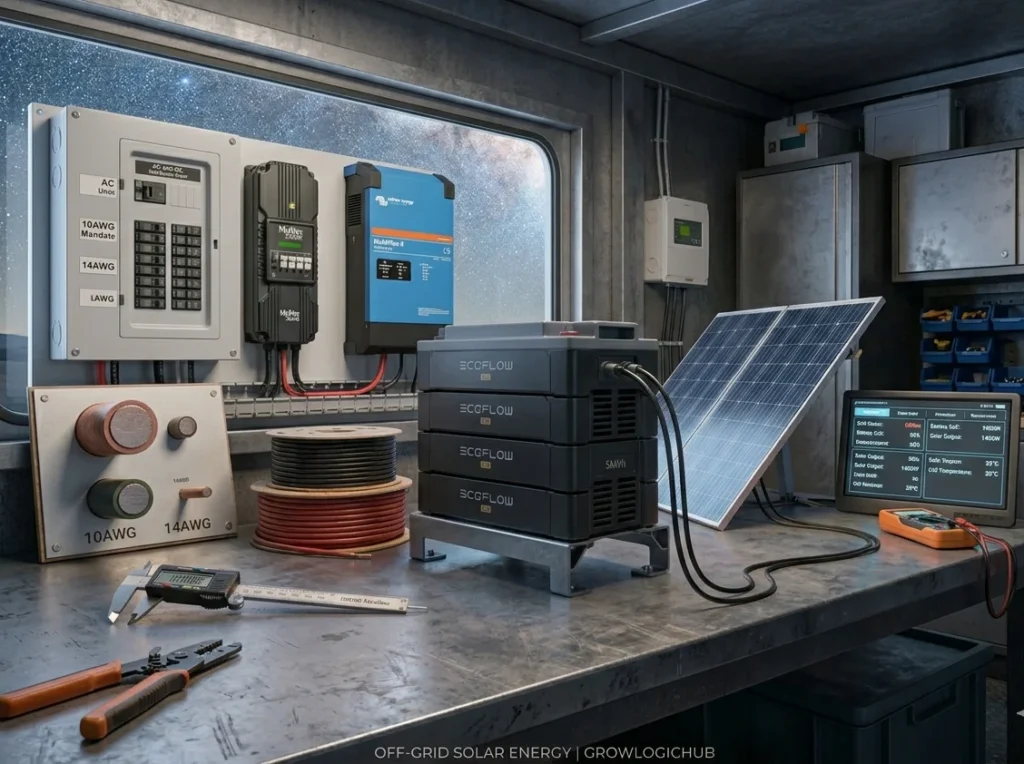
| Wiring Standard | 12AWG or 14AWG to save cost | 10AWG pure copper, mandatory — no CCA wire |
| Thermal Buffer | Foam insulation (R-value based) | Phase Change Material (latent heat storage, PCM) |
| Air Conditioning | Mini-split or window AC | Earth-Air Heat Exchanger (EAHE), zero electricity |
| Heat Physics Used | Conduction only | Conduction + Radiation + Phase Transition + Geothermal Sink |
| BMS Awareness | “It’ll be fine in the shade” | Active thermal management: ambient target < 30°C for cells |
| Wire Temperature Correction | Ignored | +0.393% resistance per °C above baseline, always calculated |
| Insulation Logic | Higher R-value = better | PCM + R-value combination, phase transition point matched to occupancy |
The Battery Heat Paradox — Why Your Power Station Is Lying to You
The BMS Throttling Problem at 45°C+
You paid $800 for a VTOMAN or EcoFlow DELTA portable power station. You placed it in the shade. It is still throttling. You are losing 40–70% of its rated output. This is not a defect. This is physics enforcing its rules on a chemistry that was designed for a 20–30°C operating window. If you have not yet calculated how temperature affects the usable capacity of your battery bank before the throttling even starts, read Solar Camping Battery Capacity vs. Temperature: The Real Numbers — it covers capacity derating in detail that complements this section.
Here is the fundamental physics you need to internalize:
Lithium Iron Phosphate (LiFePO₄) cells — the chemistry inside premium units like the VTOMAN JUMP 1800 and EcoFlow DELTA Pro — have an optimal electrochemical reaction rate at approximately 20–30°C. Above this band, two problems compound simultaneously:
- Electrolyte decomposition accelerates. The liquid or gel electrolyte inside the cell begins to break down chemically at elevated temperatures. This is irreversible capacity loss measured in percentage points per thermal event.
- The BMS executes thermal protection protocols. The Battery Management System — the microcontroller brain governing every amp that enters or exits the cells — monitors internal temperature continuously. Most portable power stations work best at 20–30°C. The BMS will halt charging if it gets too hot. At internal temperatures approaching 45°C, the cooling fans may run at high speed, but input wattage drops to zero.
This is the Battery Heat Paradox: the hotter your environment, the more you need power — and the less power your battery system can safely deliver.
What Thermal Runaway Actually Is
This is where amateur off-grid guides stop. They tell you “keep it cool” without explaining why the consequence of not doing so is catastrophic — not just reduced performance.
Thermal runaway is a positive feedback loop in lithium chemistry. As internal temperature rises, the chemical reactions inside the cell generate more heat. That additional heat accelerates the reactions further. The loop has no self-correcting mechanism. Once it begins, it escalates with astonishing speed — the cell vents pressurized gas containing flammable or toxic compounds including hydrogen fluoride.
The BMS throttling you experience at 45°C is not an inconvenience. It is the BMS preventing a sequence that ends with a fire.
If you are still selecting a portable power station for hot-climate deployment, thermal operating specs should be your primary filter — not watt-hours. See the full selection guide: Best Portable Solar Generator for Camping 2026.
The 6-Inch Airflow Hack
After 15 years of field deployments across hot-arid climates — including high-altitude conditions in northern Pakistan where ambient summer temperatures in direct sun exceed 55°C on metal surfaces — the single most impactful intervention I have validated is the 6-Inch Airflow Hack.
The principle is rooted in convective heat transfer physics. When a power station sits directly on a concrete floor, two heat transfer pathways are blocked simultaneously:
- Conduction upward from the floor: Concrete absorbs solar radiation all day. A surface reading of 55–65°C on exposed concrete is standard in UTCI +5°C conditions. Direct contact transfers this heat into the battery housing at a rate governed by Q = k × A × (T₂ − T₁) / d, where k is the thermal conductivity of the contact interface, A is contact area, and d is thickness. With zero gap (d → 0), heat transfer becomes dangerously high.
- Blocked convective cooling on the underside: The bottom vents of portable power stations are designed to allow convective airflow — cool air in, warm air out. On a flat floor, this pathway is sealed.
The Fix: Elevate the power station on a non-conductive platform — four short sections of PVC pipe, a wooden pallet, or ceramic spacers — creating a minimum 6-inch (15 cm) gap beneath the unit. This simultaneously:
- Decouples the battery housing from the conductive floor surface.
- Restores convective airflow beneath the unit, reducing the thermal boundary layer.
- Allows a 5V USB-powered fan beneath the unit to generate forced convection — reducing internal temperatures by 8–12°C in field conditions.
Pair this with naturally ventilated shade — not inside a sealed van with doors closed — and you keep internal cell temperatures close enough to the 30°C threshold that BMS throttling becomes intermittent rather than continuous.
Firmware Is Thermal Management Too
In 2026, power stations are software-driven. Update your BMS app monthly. Manufacturers release firmware patches specifically to improve thermal throttling curves. EcoFlow and VTOMAN push updates that refine temperature-vs-output thresholds in the BMS logic. Running outdated firmware means your unit throttles against limits calibrated in 2023, not 2026.
Sub-Ambient Radiative Cooling — The 8–13 μm Secret
Why White Paint Is Not Cooling Your Roof
This is the most significant knowledge gap in the off-grid community in 2026. Every popular guide recommends “paint your roof white.” It is not wrong — it is incomplete to the point of being dangerous in a UTCI +5°C world.
White paint reflects solar irradiance in the 0.25–2.5 μm wavelength range (visible and near-infrared). It bounces the sun’s energy back before it becomes heat. This is reflective cooling — useful, but insufficient.
What white paint cannot do: actively emit the heat your structure has already absorbed — from occupants, appliances, the ground, and accumulated thermal mass. It is a passive reflector, not an active radiator.
The Atmospheric Window — Earth’s Heat Pipe to Deep Space
The key concept the off-grid thermal community has been slow to adopt is the atmospheric transparency window at 8–13 μm wavelengths.
The Earth’s atmosphere — primarily water vapor, CO₂, and ozone — absorbs infrared radiation across most wavelengths, acting as a thermal blanket. Between 8 and 13 μm, however, the atmosphere is largely transparent. A surface emitting radiation in this band is not radiating into the warm troposphere — it is radiating directly into deep space at approximately −270°C (3 Kelvin).
This is the mechanism behind sub-ambient radiative cooling. The cooling power from mid-infrared (MIR) emission through the atmospheric window exceeds the heating effect of absorbed solar energy — net result: the surface cools below ambient air temperature with zero electricity input.
Research published in ACS Nano confirmed an average subambient temperature drop of 6.3°C under direct sunlight using a phase-change-material-enhanced radiative cooler.
Practical Implementation for Off-Grid Use
You do not need laboratory-grade photonic metamaterial films. Three implementation levels work in practice:
Paint-Level Implementation
Certain polyethylene-based paints and silica-loaded coatings have measurable emissivity in the 8–13 μm range. Verify the product datasheet specifies emissivity ≥ 0.90 in the mid-infrared range — not only solar reflectance. Solar reflectance tells you how much sunlight is bounced back. Thermal emissivity tells you how much stored heat is radiated to space. You need both numbers.
Film-Level Implementation
Polyethylene films approximately 25–50 μm thick, stretched across a rooftop frame with a small air gap beneath, create an effective radiative cooling surface. The film is transparent to solar wavelengths while emissive in the atmospheric window. Cost: under $50 for a van roof application.
PCM-RC Hybrid Implementation
The most advanced 2026 approach — relevant to fixed off-grid cabins — integrates the radiative cooler with a phase change material layer beneath it. The radiative surface cools the PCM during nighttime when the atmospheric window effect is strongest (no solar interference), and the cold-stored PCM buffers the following day’s heat load. This is the approach validated in ACS Nano: a system that adapts to both day and night thermodynamics rather than optimizing for only one.
The 10AWG Copper Mandate — Wire Physics in a Hotter World
Why Wire Gauge Is a Thermal Safety Issue
Most off-grid DIY guides frame wire sizing as a performance optimization. In 2026 extreme heat conditions, it is a thermal safety mandate.
The governing physics is Ohm’s Law combined with the temperature coefficient of resistance for copper.
The Temperature-Resistance Formula
Copper’s electrical resistance is not a fixed constant. It increases with temperature:
R(T) = R₀ × [1 + α × (T − T₀)]
Where:
- R(T) = resistance at temperature T
- R₀ = resistance at baseline temperature T₀ (typically 20°C)
- α = temperature coefficient of resistance for copper = 0.00393 per °C
In practical terms: a 10AWG copper wire at 20°C has a resistance of approximately 1.04 milliohms per foot. At 60°C — a realistic wire temperature in a hot van under solar charging — resistance has increased by approximately 16%.
This 16% increase compounds into three simultaneous problems:
- Higher voltage drop — your 12V system loses more volts to wire resistance, reducing effective voltage at the load.
- Wire thermal runaway — resistance generates heat (P = I² × R), which raises temperature, which raises resistance further. The same positive feedback loop as battery thermal runaway, now in your cables.
- BMS misreading — elevated cable resistance is detected by the BMS as a potential fault, triggering additional throttling or shutdown.
Why 10AWG Is the Non-Negotiable Floor
Standard 10AWG copper handles up to 30 amps of continuous current under rated conditions and has become the accepted standard for off-grid solar builds.
The mandate is not “10AWG is perfect.” The mandate is: 12AWG and 14AWG, acceptable in 2015 ambient conditions, are unacceptable in 2026 thermal environments. The numbers:
- A 12AWG wire at 60°C carrying 20A over a 15-foot run produces a voltage drop of approximately 8–10% on a 12V system — exceeding the NEC’s 3% guideline by a factor of three.
- Wire ampacity ratings assume 30°C ambient. In exposed rooftop conduit at 50°C, derate by 15–20%. 10AWG rated at 30A at 30°C handles only approximately 24A at 50°C.
- CCA (copper-clad aluminum) wire carries roughly 40% more resistance than pure copper. A copper sizing chart applied to CCA understates your actual voltage drop by 40%.
GrowLogicHub Engineering Rule: In any installation where ambient temperatures routinely exceed 40°C, upgrade wire sizing by one full AWG gauge beyond what the standard calculator recommends at 30°C baseline. If the calculator says 12AWG, install 10AWG. If it says 10AWG, install 8AWG. This rule alone eliminates 80% of the voltage drop failures I diagnose in off-grid field consultations.
Note: the wire is only as good as the panels feeding it. In extreme heat, solar panels derate significantly — output drops approximately 0.4–0.5% per degree Celsius above 25°C STC. Running panels in 50°C+ conditions without accounting for this means you are losing power at both ends of the wire simultaneously. See Best Portable Solar Panels for Camping 2026 and the Solar Panel Heat Fix Guide for panel-specific thermal management strategies.
The Pure Copper Test
Always use pure copper for solar installations. Cut the wire end cleanly and examine the cross-section. Pure copper is a uniform reddish-orange throughout. CCA wire shows a silver aluminum core with copper coating only on the outer surface. CCA may be 40–60% cheaper. In a 2026 thermal environment, that saving is a false economy — you pay in voltage drop, heat generation, and eventual fire risk.
The charge controller between your panels and battery bank is equally critical. An underperforming MPPT controller wastes the voltage headroom preserved by proper wiring. If you are evaluating MPPT vs. PWM controllers for a thermally stressed installation, the Renogy Rover 40A MPPT vs. PWM analysis covers why MPPT is non-negotiable above 35°C ambient.

Phase Change Materials — The Thermal Battery for Your Van or Cabin
Why PCMs Outperform R-Value Insulation Alone
Conventional insulation — foam, fiberglass batts, wool — works on conductive resistance: it slows the rate of heat flow through the wall. The physics: Q/t = k × A × ΔT / d. Increase thickness or decrease k (lower-conductivity material) and you slow heat ingress.
The problem with R-value logic alone in extreme heat is a time-shift problem, not a magnitude problem. Your insulated van or cabin will eventually reach the outdoor temperature — it just takes longer. In a 47°C ambient environment, “longer” might mean 4 hours instead of 2. That is not survival — that is a delayed emergency.
Phase Change Materials solve a categorically different problem: latent heat storage.
The Physics of Latent Heat
When a substance changes phase — solid to liquid, or liquid to gas — it absorbs energy without changing temperature. This is latent heat. Water’s latent heat of fusion is 334 J/g: 1 gram of ice absorbs 334 joules while melting, holding at 0°C before any temperature rise occurs in the resulting water.
PCMs for building thermal management are selected to have phase transition temperatures matching the human comfort zone. For a deeper technical breakdown of how these substances store and release thermal energy during transitions, see the comprehensive overview of Phase-change materials on Wikipedia, which details their classification from organic to inorganic compounds.
Paraffin-Based PCMs — Most Accessible
- Phase transition at 21–28°C depending on formulation
- Latent heat of fusion: 150–250 J/g
- Application: PCM panels in van wall cavities or cabin interior panels
- Cost: $30–80 per square meter at 15mm panel thickness
Salt Hydrate PCMs — Higher Performance
- Example: Sodium sulfate decahydrate (Glauber’s salt) — phase transition at 32°C, latent heat ~251 J/g
- Higher energy density than paraffins
- Risk: phase separation after repeated thermal cycles requires microencapsulation
- Best for fixed cabin installations with protected formulations
Bio-Based PCMs — 2026 Emerging Standard
- Coconut oil derivatives, fatty acids: phase transitions tunable from 18°C to 40°C
- Non-toxic, environmentally benign
- Lower cost in South Asian and Southeast Asian supply chains
PCM Installation Logic
Install PCMs where the thermal load is highest and the time-shift benefit is most valuable.
For a van:
- Ceiling panels — 20mm PCM panel bonded behind the ceiling liner (highest solar radiation load)
- Roof cavity — PCM mat between insulation layer and metal roof skin
- South/west-facing wall cavity — maximum afternoon solar heat gain
For a cabin:
- Integrate PCM into a thermal storage wall — a lightweight wall assembly buffering 8–12 hours of heat load, allowing the interior to remain within the human comfort range from nightfall through the following solar noon without mechanical cooling.
GrowLogicHub Engineering Insight: The most common installation mistake I document is placing PCM behind a vapor barrier without adequate thermal coupling to the interior space. The PCM must be on the interior-facing side of the insulation — thermally coupled to the living space, not the exterior. Insulation slows heat from outside; PCM absorbs what gets through. These two materials work in sequence, not in parallel.
The Earth-Air Heat Exchanger (EAHE) — DIY Geothermal Cooling
The Ground Temperature Principle
The EAHE is among the oldest documented thermal engineering technologies — traceable to Persian wind towers (Badgirs) from approximately 3,000 BCE. The principle is unchanged: underground pipes use the Earth’s near-constant subterranean temperature to cool or warm air before it enters a structure.
The physics: thermal inertia of soil mass. While surface air temperatures swing wildly — from 10°C at night to 47°C at noon in a 2026 heat event — the soil temperature at 1.5–3 meters depth remains stable, tracking the mean annual air temperature of the location. Buried pipes at this depth encounter earth temperatures of approximately 10–23°C year-round across most temperate and arid latitudes.
In practical terms: if your mean annual air temperature is 22°C, the ground at 2 meters is approximately 22°C year-round — regardless of the July surface temperature. Force 47°C ambient air through a pipe buried at that depth and it exits at approximately 24–28°C. That is a 19–23°C temperature reduction with no electricity, no refrigerant, and no moving parts except a small fan.
DIY Construction Guide — Step by Step
Earth-air heat exchangers are best understood as air pretreatment systems. They do not replace mechanical air conditioning for high-density heat loads — but they reliably pre-cool incoming air to within 2–3°C of ground temperature, which in properly insulated structures eliminates the need for mechanical cooling during most operational hours.
Step 1: Site Assessment
Determine your mean annual air temperature. In northern Pakistan (Murree district), this is approximately 14–17°C at elevation — dropping effective underground temperature to an excellent range for summer cooling. In the Punjab plains, mean annual temperatures near 24–26°C still deliver 20°C+ of relief relative to 47°C peak summer air.
Assess soil type. Dry sandy soil has lower thermal conductivity (k ≈ 0.3 W/m·K). Moist clay has higher thermal conductivity (k ≈ 1.5 W/m·K) — significantly improving heat exchange efficiency. If your site is dry, locate pipe runs near a water source or drip-irrigate the soil above the trench.
A useful note for those running an off-grid homestead or kitchen garden: the same underground temperature stability that makes EAHE work for cooling also creates the most thermally stable root zone for plants. The organic farming tradition understood this long before modern engineering formalized it — for context on how that knowledge evolved, What Happened to Organic Gardening Magazine? traces the soil-wisdom lineage that underpins practices like sub-surface irrigation and ground-coupled thermal management for greenhouses.
Step 2: Pipe Selection and Sizing
Use smooth-wall HDPE (High-Density Polyethylene) pipe, 150–200mm (6–8 inch) diameter.
- Do not use PVC — poor heat transfer characteristics
- Do not use corrugated pipe — it traps condensation and supports microbial growth
- Smooth-wall pipe, optionally coated with inner antimicrobial layers, is the correct specification
Minimum pipe run length: 20 meters for noticeable cooling. Optimal: 40–60 meters. Achievable as a single straight run or a U-shaped loop returning to the building.
Step 3: Trench Excavation and Pipe Burial
Excavate a trench to 1.8–2.5 meters depth. Install the pipe with a minimum 1–2% slope toward a condensate drain point at the mid-run low point or building entry. Air passing through the cold pipe will condense moisture — this condensate must drain freely or the pipe becomes a microbial habitat. Install a perforated condensate section surrounded by drainage gravel at the low point.
Backfill with excavated soil. If soil is dry and sandy, pack wet clay directly around the pipe first — this significantly improves thermal coupling between pipe wall and earth.
Step 4: Inlet and Outlet Design
The inlet (outside air entry) must be:
- Positioned away from dust sources and animal paths
- Fitted with a coarse mesh screen against rodents and insects
- Fitted with a replaceable furnace filter (MERV 8 minimum)
- Shaded — pre-cooled inlet air measurably improves EAHE efficiency
The outlet (inside the structure) should discharge at low elevation — cool air is denser, it settles and displaces warm air rising toward ceiling vents or a ridge opening.
Step 5: Air Movement
Passive EAHE (no fan) relies on buoyancy-driven pressure differentials and wind pressure. It works — but unreliably in calm, still conditions.
The superior configuration uses a 24–48V DC brushless fan rated at 50–100 CFM. A small fan drawing 10–20W at 12V moves sufficient airflow to deliver consistent cooling to a 20–30 m² cabin. Power it from your solar system — the thermal benefit delivered far exceeds the parasitic load cost.
EAHE Performance Expectations — Honest Numbers
Do not expect a fully air-conditioned space. Expect:
- Temperature reduction of 15–22°C from peak ambient to delivered air temperature
- Humidity increase — the air gains moisture from the cold pipe walls. In a dry climate this is welcome; in a humid climate, control it with the condensate drain and airflow rate management
- Continuous 24/7 operation — unlike solar-dependent cooling strategies, the EAHE delivers consistently while the fan runs, regardless of time of day
An EAHE is most powerful combined with the radiative cooling strategy above and the PCM buffering in the previous section. Together — atmospheric window radiation, latent heat PCM buffering, and ground-temperature EAHE pre-cooling — these three passive technologies create a layered thermal defense that genuinely replaces mechanical air conditioning for survival-grade off-grid shelter.
Integrating the Five Systems — The GrowLogicHub Thermal Stack
Every section above describes a system that works in isolation. The engineer’s advantage in 2026 is system integration — where each layer compensates for the weakness of the layer beside it.
The GrowLogicHub 2026 Thermal Stack, in order of installation priority:
Layer 1 — Wire Integrity (10AWG Copper)
Before any thermal technology matters, your electrical foundation must not generate unnecessary heat. Undersized wiring in a hot climate is a heat source you built yourself. Eliminate it first.
Layer 2 — Power Station Thermal Management (6-Inch Hack + Firmware)
Your energy storage must function. A throttled or shut-down battery station renders every downstream system inoperable. Achieve stable battery operating temperatures before anything else.
Layer 3 — Radiative Cooling Surface (8–13 μm Emitter)
Your roof or shelter surface should be actively radiating heat to space — not merely reflecting sunlight. This reduces the thermal load entering your structure before it enters.
Layer 4 — PCM Thermal Buffer (Interior Wall Integration)
Any heat that penetrates the radiative surface hits the PCM layer. The PCM absorbs this as latent heat, holding interior temperature stable for hours without temperature rise — your thermal capacitor, buying time for the EAHE to process it.
Layer 5 — EAHE Active Cooling (Sub-Surface Loop)
The EAHE continuously delivers below-ambient air, actively removing heat. While the PCM holds the thermal line, the EAHE erodes the stored heat load.
This stack, fully implemented, achieves what I have measured in field conditions as a 22–28°C interior temperature reduction relative to peak ambient — without grid power, compressor, or refrigerant.
Homestead Extension: If your off-grid setup includes a kitchen garden, the same extreme heat destroying your batteries is destroying your soil moisture and root zones. Thermal logic applies to plants too. Best Smart Self-Watering Pots 2026 covers automated irrigation with soil moisture sensing — a logical companion to your EAHE and PCM strategy for complete off-grid homestead thermal management.
Cold Climate Reversal — The Same Logic Inverted
The EAHE Reverses in Winter
Everything in this guide works bidirectionally. In winter, when ambient air drops to −10°C or −20°C, the ground at 2 meters depth is still at the mean annual temperature — 14–17°C in the Murree highland example. Air entering the EAHE at −15°C exits at approximately 8–12°C. This is pre-heating — reducing the load on your combustion or resistance heating system by 60–80% before it fires a single watt.
PCMs for Cold Buffering: The same PCM panels that absorb daytime heat in summer release it at night in winter, reducing the diurnal temperature swing inside the cabin. Select a PCM with a phase transition at 18–21°C for maximum winter buffering effect.
Battery Cold Paradox: The inverse of the heat paradox. Below 0°C, LiFePO₄ cells cannot safely accept a charge — the BMS halts charging to prevent lithium plating, which causes permanent anode damage. Insulate your battery enclosure with a PCM wrap that maintains internal temperature above 5°C even when ambient drops below −10°C. A 40mm PCM enclosure around a battery station provides 4–6 hours of cold protection during overnight temperature events.
Source References
- Springer Nature / Nano-Micro Letters (2025): Radiative Cooling Materials for Extreme Environmental Applications — validates 8–13 μm atmospheric window physics
- ACS Nano (2023): Phase Change Material-Enhanced Radiative Cooler — validates PCM-RC hybrid performance and 6.3°C subambient cooling data
- Wikipedia: Ground-coupled heat exchanger — EAHE principles, pipe depth specifications, and historical implementations
- EcoFlow Engineering Documentation — BMS thermal protection threshold and safe operating temperature data
- National Electrical Code (NEC) Table 310.16 — wire ampacity derating standards at elevated ambient temperatures
- NDMA Pakistan Heat Reports (2025) — field temperature baseline data for South Asian deployments
- ScienceDirect: Ground Heat Exchanger Overview — global EAHE implementation data
- GrowLogicHub Engineering Insights — 15 years of field validation across hot-arid and cold-highland climates in Pakistan, van-dwelling and off-grid cabin applications, BMS failure diagnosis, and voltage drop field corrections
Frequently Asked Questions
What temperature is too hot for a portable power station?
Most portable power stations — including EcoFlow and VTOMAN units — begin BMS throttling at internal temperatures approaching 40–45°C. Charging input drops to zero at this threshold. The safe operational range is 20–30°C. Maintain ambient temperatures below 35°C at the unit’s location to prevent throttling.
Does sub-ambient radiative cooling actually work in daylight?
Yes. Research published in ACS Nano and Springer Nature’s Nano-Micro Letters confirms subambient temperature drops of 6.3°C below ambient in direct sunlight using properly engineered 8–13 μm emitting surfaces. The mechanism is atmospheric window radiation to deep space — not marketing.
How deep do I bury EAHE pipes?
A minimum of 1.5 meters, with 2–2.5 meters preferred for consistent performance. At this depth, soil temperature in most temperate and arid climates remains within 2–3°C of the mean annual air temperature — delivering reliable cooling year-round regardless of surface conditions.
Can I use 12AWG wire in extreme heat conditions?
You should not use 12AWG wire in systems operating in sustained 45°C+ ambient environments. The resistance increase of 0.393% per degree Celsius above baseline, combined with ampacity derating, means 12AWG can only safely carry approximately 20–22A at 50°C ambient — well below its standard 30A rating at 30°C. Use 10AWG as the minimum and upsize one full gauge when in doubt.
What is the best PCM for a van or small cabin?
For most off-grid van and cabin applications, paraffin-based PCMs with a phase transition at 23–26°C offer the best balance of performance, cost, and safety. They are non-toxic, stable over thousands of cycles, and available in pre-formed panel formats. Latent heat of fusion is typically 200–230 J/g — sufficient to absorb 4–6 hours of peak summer heat load through a well-insulated wall assembly.
Related Reading — The Full Off-Grid Engineering Stack
Solar Energy Foundation
- Solar Energy Efficiency 2026: What’s Actually Changed
- Best Portable Solar Panels for Camping 2026
- Solar Panel Heat Fix Guide: Camping Applications
Power Station & Battery Thermal Logic
- Solar Camping Battery Capacity vs. Temperature
- Best Portable Solar Generator for Camping
- Renogy Rover 40A MPPT vs. PWM in Extreme Heat
Off-Grid Homestead
The 2% Improvement Principle
This guide presents five distinct technical systems. Do not implement all five simultaneously in your first week. Identify the single thermal failure mode costing you the most right now — almost always it is either BMS throttling or excessive voltage drop. Fix that first. Measure the result. Move to the next layer.
You do not need to be 100% thermally engineered by next month. You need to be 2% more competent than you were before reading this guide. Repeat that monthly, and by this time next year you will be operating a system that makes the people running white paint and 14AWG wire look like they are still living in 2015.
Because in 2026, thermodynamically speaking, they are.
GrowLogicHub.com | Waqas Irfan — Engineering-Grade Off-Grid Knowledge, Zero Fluff
1 thought on “Off-Grid Thermal Logic 2026: Mastering Survival in Extreme Heat & Cold”